Free restaurant menu redesign
What a real restaurant menu redesign looks like — and how to get one free
Most restaurant menus underperform not because the food is wrong, but because the menu says something different than the restaurant. This page shows three real before-and-after redesigns from independent restaurants — and how you can get the same process applied to your menu, free, in about ten minutes.
Why most restaurant menus are working against you
A menu is the only piece of communication a guest has while deciding what to spend money on. It sets price expectations before a single dish arrives. It signals whether the experience is casual or considered. It tells the kitchen which dishes need to be fast and which ones can be slow. A poorly designed menu makes all of those jobs harder — for guests, for servers, and for the owner.
The most common problems are not exotic. They are: too many items, type that is too small to read in dim light, section names that don't match how guests order, prices that compete visually with dish names, and an overall aesthetic that was copied from a template rather than built from the restaurant's actual identity. The fix is not expensive illustration or custom print. It is hierarchy, restraint, and a consistent voice.
A menu redesign also doesn't have to cost thousands of dollars or take weeks with a graphic designer. The three examples below each went from original to redesigned in a single session using Menuist — an AI-assisted process that starts with your actual menu and your restaurant's concept, not a blank template.
3 real restaurant menu redesigns
These are not demos. Same dishes, same prices — just a different layout, type, and visual direction. The before image is the original live menu; the after is the Menuist redesign PDF.
Catch 109
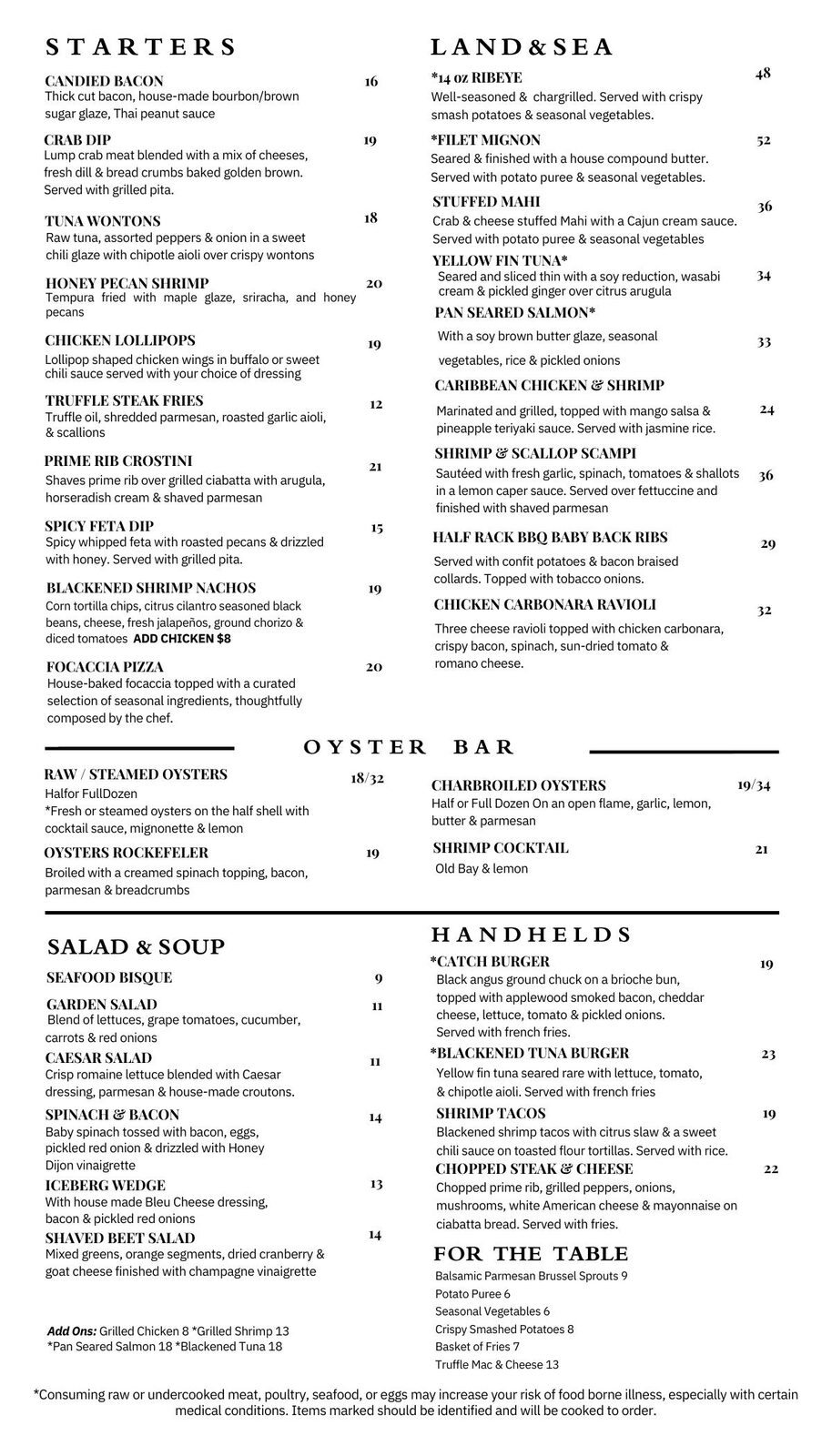
Morehead City, NC · Waterfront seafood restaurant
The problem
A dense PDF of type with no visual hierarchy and no coastal atmosphere. Guests couldn't scan the sections quickly and the menu gave no clue the place sat on the waterfront.
The fix
Clean editorial layout: generous whitespace, a single refined typeface, and a section structure that guides the eye from starters to mains without visual competition.
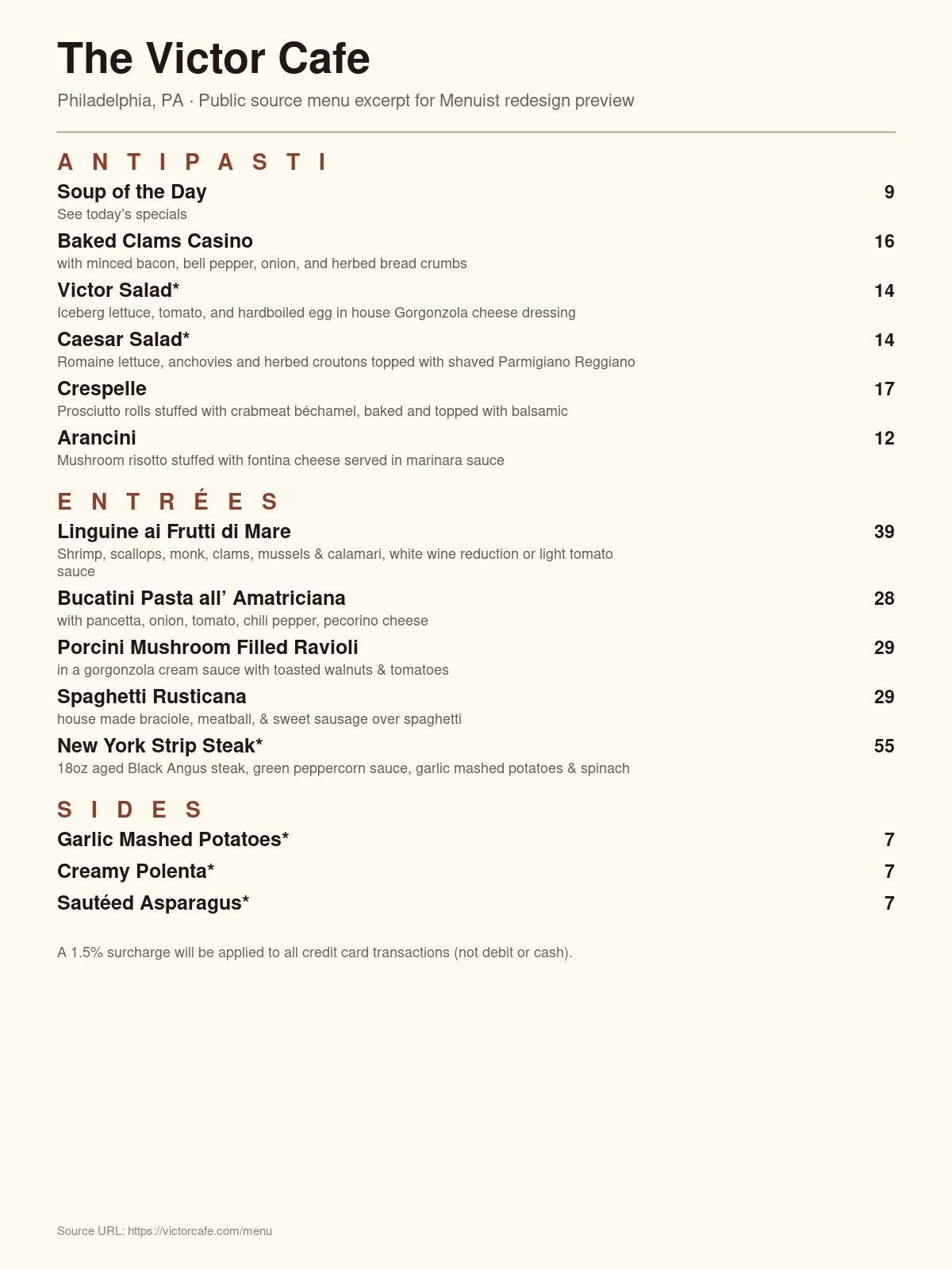
The Victor Cafe
Philadelphia, PA · Italian opera café — est. 1918
The problem
Philadelphia institution where opera singers perform tableside, but the menu was a flat listing with no editorial presence — nothing to match the venue's 100-year legend.
The fix
Heritage broadside treatment: operatic typographic hierarchy, warm ivory tones, and details that feel as old and serious as the dining room they belong to.
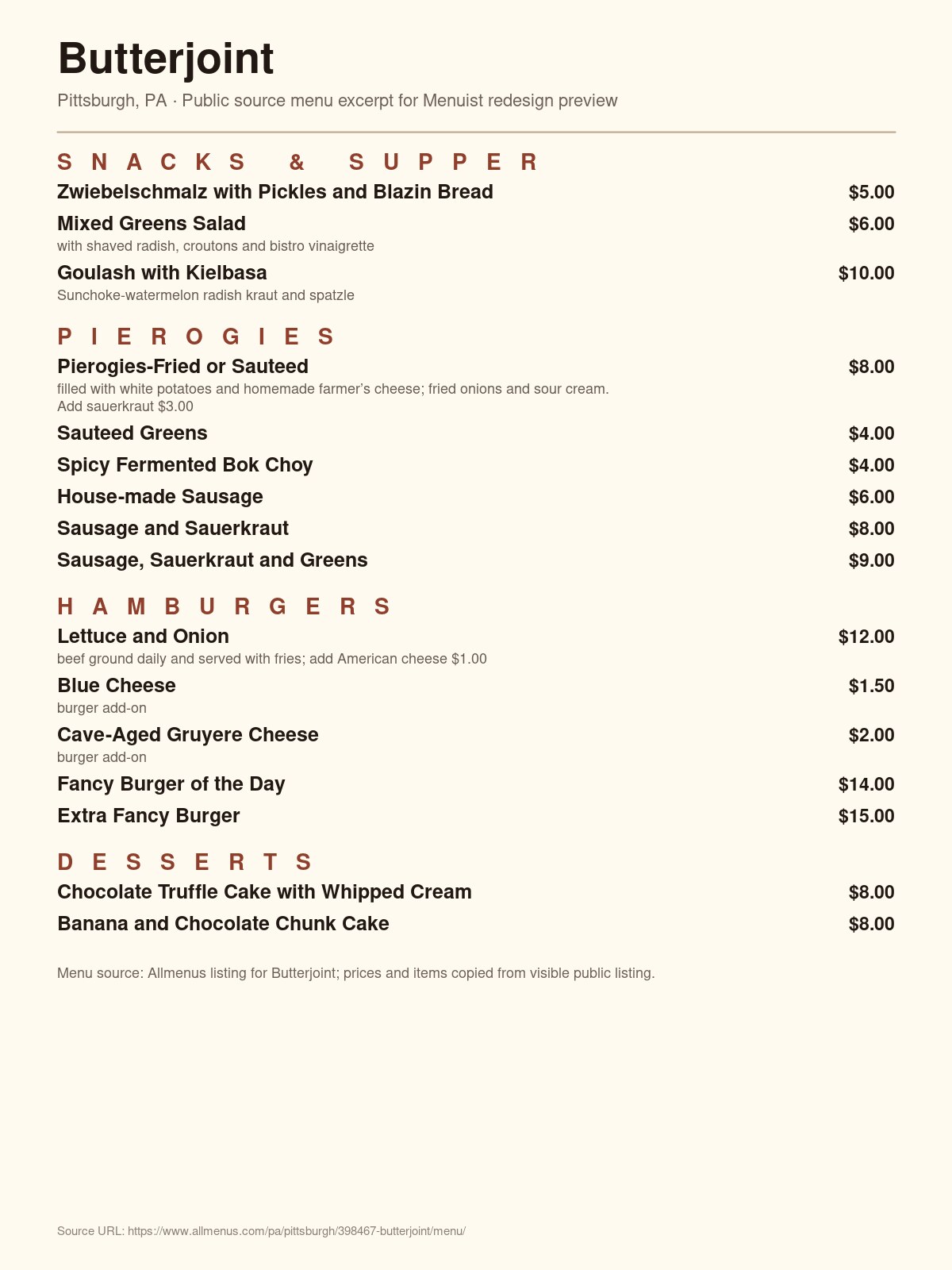
Butterjoint
Pittsburgh, PA · Craft bar & kitchen
The problem
A working bar menu that did the job but nothing more. No identity, no weight contrast, no signal that the beer program was serious.
The fix
Editorial restraint: strong weight contrast between section headers and items, deliberate spacing that makes the menu feel curated rather than listed, and a tone that fits the craft-beer culture.
Try it on your real menu
Get a free redesign demo, then preview yours for $49.
Upload your current menu, describe your restaurant, and Menuist produces a full visual direction in about ten minutes. No designer, no templates, no setup fee. When the direction feels right, unlock a one-page watermarked preview PDF for $49 — before committing to final print-ready files.
How the free restaurant menu redesign process works
The Menuist design process starts where most tools skip: the restaurant itself. Before producing anything visual, it runs a diagnostic on your concept — positioning, customer profile, atmosphere signals, and what the current menu communicates versus what you intend. That analysis becomes the creative brief for everything that follows.
From the brief, Menuist generates three distinct creative universes: different typographic moods, palette directions, and structural approaches matched to your restaurant type. You pick the direction that feels right. The tool then produces a detailed visual design board — font specimens, color swatches, layout logic — so you can see the full language before committing to a finished menu.
The final step takes the design language and your real menu content and produces a redesigned PDF. The free demo shows you everything up to that point. The $49 watermarked preview applies the redesign to one page of your actual menu. The $149 full design delivers the complete print-ready file.
No subscription, no design brief calls, no revision cycles. The whole process runs in the browser in about ten minutes.
When a full menu redesign is worth it
Not every menu problem needs a full redesign. If the layout and typography are solid and you just need to update prices or add seasonal items, a quick edit usually suffices. But there are clear signals that a full redesign will pay for itself quickly:
- —Guests regularly ask servers to explain the menu or what to order — the layout is failing to orient them.
- —You opened with a generic template and the restaurant has since developed a stronger identity.
- —You have added a dozen items over two years and the sections no longer make sense.
- —Servers say people keep ordering the same two or three safe items and ignoring the dishes with better margins.
- —The printed menu looks noticeably different from how the restaurant now presents itself on Instagram or on-site signage.
- —You are raising prices and the current menu looks like it belongs at a lower price point.
If two or more of these are true, a redesign is the more efficient fix. A new layout and visual language resolves all of them at once instead of patching each symptom separately.
What a good restaurant menu redesign includes
A surface-level redesign swaps fonts and colors. A real redesign evaluates the information architecture first — whether the sections match the way guests order, whether item names are leading with the right information, whether prices are positioned well, and whether the visual weight of the page guides the eye toward the dishes that matter most to the business.
From there it establishes a design language specific to the restaurant: not a color palette chosen from a wheel, but a set of typographic relationships, whitespace proportions, and visual cues that match the atmosphere, price point, and neighborhood the restaurant belongs to. That specificity is what separates a redesign from a re-template.
Finally, it should produce a file the restaurant can actually use. A print-ready PDF at the right dimensions, with bleed if required, and at a resolution that doesn't look blurry when printed. See the full showcase for six complete before-and-after redesigns with downloadable PDFs.
Ready to see what your menu could become?
The free demo takes about ten minutes and shows you a full creative direction built from your restaurant's actual concept — not a generic template. Preview the redesign for $49, then order the complete print-ready PDF for $149 when you're ready.
One-time payment · No subscription · Print-ready PDF included